

Dr. Harry Edwards and Coach Bill Walsh
“If a strategic part of our struggle is NOT to convert critics, adversaries, and the apathetic into collaborators, allies, and advocates, then what are we struggling for – to replace their denunciation and repression of us with our denunciation and repression of them?”
Dr. Harry Edwards, in a 1985 note to San Francisco 49ers Head Coach Bill Walsh
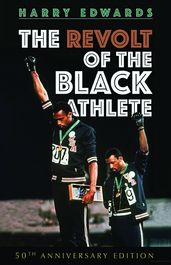
There are few more iconic images of protest and revolt than the raised fists of John Carlos and Tommie Smith on the victory stand at the 1968 Olympics in Mexico City. This immortal act of defiance was organized by Harry Edwards, a sociology professor with a PhD from Cornell University. Edwards grew up in the tough, segregated neighborhood of East St. Louis in the 1940s and 1950s, was a star athlete in several sports, attended San Jose State College (now San Jose State University) on an athletic scholarship, and was a professor at the University of California at Berkeley for more than 30 years.
Dr. Edwards was a civil rights leader with close associations with Dr. Martin Luther King, Malcolm X, Huey Newton, H. Rap Brown, and countless others. He counseled many of the greatest athletes of all time, including Muhammad Ali, Kareem Abdul-Jabbar, Jim Brown, Jerry Rice, and Colin Kaepernik, as well as the three-time Super Bowl-winning head coach of the San Francisco 49ers, Bill Walsh.
On April 11, 2025, I spoke with my former professor at UC Berkeley, Dr. Edwards, and we had the following conversation:
RITKES: Dr. Edwards, you were very active in the Civil Rights Movement from the Sixties through the present. You met with Dr. Martin Luther King Jr., Malcolm X, Huey Newton, and H. Rap Brown, and organized boycotts and protests, including one for the 1968 Olympics. As a sociology professor, what inspired you to focus so much of your activism on sports?
EDWARDS: I was born in 1942, and when you look at that era, two things stand out as impacting me. One was the 1917 White riots in East St. Louis, Illinois, where more than 3,500 Black people fled across the East Bridge into Missouri as refugees. More than 300 Black people were murdered in East St. Louis as a result of those riots. In the community where I grew up, much of that cultural history was still alive and talked about by the people who lived through it. The second thing was the impact of athletes like Jesse Owens and Joe Louis and Jack Johnson, and Major Taylor [world champion cyclist, first Black sports superstar]. They had a phenomenal role in terms of perceived opportunities for Black people.
So, sports was huge. The first Christmas gift my father ever bought me was a pair of boxing gloves. He looked at Joe Louis and Jersey Joe Walcott, and said, “Hey, that’s the way for us to go.” Sports, discrimination, lynchings — these influenced me tremendously, and that persisted through the years of my education.
I was part of the 1950s generation, where you saw the first en masse integration of schools in East St. Louis. Brown versus Board of Education was in 1954. In 1955, they began to desegregate the elementary schools; in 1956, the junior high schools; in 1957, the high school in East St. Louis. But once Black people got to the East Side, as it was called, they had no idea about what to do with us. So we were channeled into sports, which was something I was well aware of and comfortable with. Sports is an arena where there’s a level playing field for Negroes. We played football in the fall, basketball in the winter, and track and field in the spring. But in terms of what went on in the classroom, they had no idea. White teachers had no idea what to do with us. They never laid a glove on us in the classroom. Whatever we happened to learn during the school day, we forgot on the bus on the way back to the Negro neighborhoods, because it had no relevance to anything we had to deal with. That was my experience — those are the things that molded me between 1942, when I was born, and 1959, when I left East St. Louis, coming to California as a scholarship athlete.

Dr. Harry Edwards and Malcolm X
RITKES: In your groundbreaking book, The Revolt of the Black Athlete, you state that one ofthe early indications that a revolt of Black athletes was in the making was a book by Bill Russell, Go Up for Glory, in 1965. What was significant about this book?

EDWARDS: The thing that struck me about Bill Russell — he was the most intelligent athlete I have ever encountered. A lot of people took his thinking process as being unable to cope socially, or awkward, or hard to get along with. Bill Russell was a thinker, and I was always impressed by that. The late 1950s and into the 1960s were a particularly volatile era because of the impact of the Civil Rights movement on athletes who utilized their athletic stage as a vehicle to make statements about society. Go Up for Glory was a major contribution to a burgeoning new era of Black athlete activism. Jackie Robinson, Larry Doby [the second African-American to play major league baseball, the second African-American to become a manager of a major league baseball team (behind Frank Robinson)], Kenny Washington [the first African-American to sign a contract with an NFL team in the modern era; played football at UCLA], Woody Strode [decathlete and football star, one of the first African-Americans to play pro football, later an actor], Marion Motley [the second African American to play pro football; was a leading fullback, rusher and blocker in the late 1940s through the 1950s], and most certainly, Chuck Cooper [the first African-American drafted into the NBA, in 1950, by the Boston Celtics, under Coach Red Auerbach].
In 1950 and 1951, it was a struggle for access. By the time Bill Russell came along, the struggle was for dignity and respect, and Bill did a better job of that than almost any athlete of that era. Certainly, Elgin Baylor was there when he sat out a basketball game in Charleston, West Virginia, after he and a couple of Black athletes on the Lakers came downstairs from the hotel and wanted to eat in the cafeteria where their White teammates were eating, and they were told, “We don’t serve Negroes.” So, Baylor said, “Okay, I’m not going to play tonight.” And he sat on the end of the bench. A year and a half later, in 1961, Bill Russell chose not to sit at the end of a bench when in Lexington, Kentucky, when he found that he and K.C. [Jones] and Sam [Jones] and a couple of other athletes could not eat in the restaurant in their hotel. Russell simply got on a plane and went back to Boston and told Red Auerbach [coach of the Boston Celtics], “I’m not playing.” Auerbach said, “Well, you can sit on the bench.” Russell said, “No, I’m going back to Boston. I don’t even want to be down here.” He never fell for this notion that sport was somehow a citadel of brotherhood and equality. He saw it for what it was, and he acted upon it and did a heck of a job in terms of articulating all of that.

Left to right (bottom row): H. Rap Brown,
John Carlos, Dr. Harry Edwards, Stokely Carmichael
RITKES: I’m surprised that segregation against Black athletes still existed in the mid-Sixties. Was there any organized protest by Black athletes against this in the mid-Sixties?
EDWARDS: There was not an organized protest along the lines of the Olympic Project [organized by Harry Edwards for the 1968 Olympics]. Some individual athletes took stands, but getting athletes organized and mobilized to articulate issues in a more militant and direct fashion was rare. The ice was broken in the mid to late 1960s. One example is the so-called “Cleveland Summit,” in 1967, where [football running great] Jim Brown called together some of the greatest Black athletes of that era. The purpose was to determine the seriousness and commitment of Muhammad Ali when Ali refused to be drafted into the army during the Vietnam War. Jim Brown himself was a second lieutenant in the military, coming out of Syracuse University, and there were athletes at the Summit that had relatives in the military, some of them fighting in Vietnam. They were there to question Ali. At the end of that session, Jim said that Muhammad answered all questions directly as far as the draft was concerned. He said we do not necessarily agree with what Muhammad is doing, but we support his right to do it.
Before the 1967 “Cleveland Summit” and the 1965 Olympic Project for Human Rights, the American Football League All-Stars forced the league to move the All-Star game from New Orleans to Houston due to racist discrimination encountered by Black players in the French Quarter. This was a “bridge” between the era of the struggle for access and the 3rd wave of Black athlete activism in pursuit of dignity and respect.
The “Cleveland Summit” was one of the true high watermarks of athlete organization around an issue involving the role of athletes in sports and the broader society. After the 1967 “Cleveland Summit,” a reporter asked Bill Russell about Jim Brown’s comments. Russell’s comment was, “I’m not worried about Muhammad Ali. Ali has found something he believes in so deeply that he’s willing to die for it. I’ve never come close to anything like that. I’m worried about the rest of us.” And that was typical Bill Russell.
RITKES: Wasn’t Kareem Abdul-Jabbar also at the Cleveland Summit?
EDWARDS: Jabbar, Bill Russell, Jim Brown, and Muhammad Ali were the four principals, but behind them were 10 or 12 outstanding athletes who came in to serve as essentially a jury of Muhammad Ali’s peers, who would evaluate and assess the level of his sincerity when he refused to be drafted. And I’ll tell you something else that I strongly suspect. I think that without the Cleveland Summit, the United States Supreme Court would not have come down as it did in finding the validity of Muhammad Ali’s case.
Editor’s Note: In 1964, while Ali was heavyweight boxing champion of the world, he was drafted into the Army. But he flunked the verbal part of the entrance test and was rejected by the military. As the Vietnam War escalated, standards were changed, and Ali was re-classified as 1-A, making him immediately eligible to be inducted into the Army. Ali stated that his religious beliefs precluded him from going to war and that he was a Conscientious Objector to war. The claim was rejected by the government, but ultimately his case was decided, in 1971, by the U.S. Supreme Court, which voted unanimously to uphold his C.O. status and exempt him from the military. Boxing authorities had stripped Ali of his title in 1967 and prohibited him from boxing, in the prime of his career, until 1970.

Ali-Sonny Liston, 1965 (photo by Neil Leifer)
RITKES: Was Muhammad Ali’s sincerity ever in question?
EDWARDS: Muhammad Ali’s sincerity was not so much in question as it was unknown. Initially. Once it became clear that he was a member of the Nation of Islam and was opposed to the war, he shifted his case from being incompetent and unqualified to being against war on religious grounds, opposed to going 10,000 miles away “to kill somebody who never called me nigger.” That is what they were interested in — looking into his level of sincerity and commitment. It wasn’t that they doubted his sincerity. It just was not clear since he had shifted positions.
RITKES: I see. Your book, The Revolt of the Black Athlete, which came out in 2017 with the 50th anniversary edition, begins with a dedication to Muhammad Ali, whom you met in 1960 when Ali was 18 years old, training for the Rome Olympics. What has knowing Ali meant to you, and what are some of the contributions Muhammad Ali has on sports and the world?
EDWARDS: As I stated in the introduction to the book, it is only when a giant passes from among us and we stand blinking into the glaring reality of our loss that we come to understand the extent to which we have only been living in his shadow. Muhammad Ali was a giant of his era. He was more than just a boxer. He was a symbol of courage and commitment, and dedication. Even if you didn’t agree with the positions he took, the fact that he took those positions and stood by them was not just admirable — it was symbolic. It was something other people could look at and emulate. The shadow he cast went far beyond the boxing ring or the athletic arena. He was, at one point, the most recognizable human face on earth. He could stand with presidents and kings and queens and diplomats. He had that kind of reach as a human being. He was one of those individuals who, if you are blessed to see in your lifetime, you are tremendously privileged. I had the privilege of meeting him early on and then engaging with him in later years, and to know that as I supported his struggle to get his title back, he supported the Olympic Project for Human Rights.
“I had come to understand that there was a price to be paid. I was not surprised when they unceremoniously kicked John Carlos off the Olympic team and sent him home. I was not surprised when I was denied tenure at University of California at Berkeley; I sent for my FBI file under the Freedom of Information Act and found out they had everything in that file from my PhD dissertation to the Revolt of the Black Athlete, and over 300 pages of dispatches from the field by FBI agents, some of them involving colleagues as well as students that were placed in my classes. I was not surprised at that. This is part of the price you pay for demanding justice in the home of the brave and the land of the free. I’m quite certain that Ali was not surprised. I was not surprised at what happened to him.”
RITKES: By taking a moral stand against war and racism, Ali lost his career, his title, his income, everything. What was it like for you to see this?
EDWARDS: It was something I came to understand based upon what I had learned from my study of sports and society. Jack Johnson paid a price. Paul Robeson paid a price. Every athlete that has ever stood up and said, “We are better than this — the racism, discrimination, persecution, political jingoism and right-wing fascism — they pay the price. Wilma Rudolph paid a price. Rose Robinson [Eroseanna Robinson, an African-American social worker, track star, activist, who organized for desegregation in the 1950s] sat on an ice cooler in 1959 at the Pan Am games in Chicago. When they asked her why she didn’t stand with the rest of the people at Soldier Field during the playing of the national anthem, she said, “I cannot stand and sing ‘home of the brave and the land of the free’ when my people right here in this country are not free.” This was in 1959, five years after Emmett Till was killed, when Black people were still being lynched across the South. That cost her an athletic career. She was a promising high jumper and track and field athlete. People don’t even know about the price that Bill Russell paid. They used to derisively call Bill Russell, “William Felton X,” in the town where he was the central figure in winning 11 championships in 13 years, because he said, “We have problems with racism in Boston. We have problems with racism in America.” I had come to understand that there was a price to be paid. I was not surprised when they unceremoniously kicked John Carlos off the Olympic team and sent him home. I was not surprised when I was denied tenure at University of California at Berkeley; I sent for my FBI file under the Freedom of Information Act and found out they had everything in that file from my PhD dissertation to the Revolt of the Black Athlete, and over 300 pages of dispatches from the field by FBI agents, some of them involving colleagues as well as students that were placed in my classes. I was not surprised at that. This is part of the price you pay for demanding justice in the home of the brave and the land of the free. I’m quite certain that Ali was not surprised. I was not surprised at what happened to him. I supported him strongly in that period. One of the demands that we made in forging the Olympic Project for Human Rights was that Muhammad Ali be given back his championship title and that his banishment from boxing be reversed. So yeah, I wasn’t surprised at any of that.
“The day that John F. Kennedy was assassinated, through the assassination of Bobby Kennedy … the murder of Medgar Evers, the bombing of the 16th Street Baptist Church that killed four little Black girls, the assassination of Malcolm X, the murder of numerous members of the Black Panther Party by law enforcement … the murder of Martin Luther King, the murder of civil rights workers and activists such as Goodman, Chaney, and Schwerner in 1964 …. It was an extremely violent era. I remember having a conversation with Huey Newton at a peace demonstration in Oakland, and this young white radical stood up and made a statement, ‘Don’t trust anybody over 30.’ And Huey and I broke out laughing because we didn’t expect to live to be 30.”
RITKES: In the year before the 1968 Olympics, you were one of the founders of the Olympic Project for Human Rights, and you had several demands, one of which you just mentioned with Ali. Can you describe the turbulence in this country and the world before the 1968 Olympics?
EDWARDS: The five years from 1963 through 1968 were the most turbulent and violent political era since the Civil War. On November 22nd, 1963, which was my 21st birthday and the day that John F. Kennedy was assassinated, through the assassination of Bobby Kennedy on June 6th, 1968 — the murder of Medgar Evers, the bombing of the 16th Street Baptist Church that killed four little Black girls, the assassination of Malcolm X, the murder of numerous members of the Black Panther Party by law enforcement between 1966 and the establishment of the Black Panther Party in 1968, the murder of Martin Luther King, the murder of civil rights workers and activists such as Goodman, Chaney, and Schwerner in 1964 — all of that took place during that period. It was an extremely violent era.
I remember having a conversation with Huey Newton at a peace demonstration in Oakland, and this young white radical stood up and made a statement, “Don’t trust anybody over 30.” And Huey and I broke out laughing because we didn’t expect to live to be 30.
And that was the nature of the era. You had Black athletes who went out and won gold medals. The greatest track team America ever fielded in the Olympics was the 1968 track team. You had people like Jim Hines and Ralph Boston. You had people coming from the HBCUs [Historically Black Colleges and Universities] who won gold medals. We weren’t protesting on behalf of a bunch of bums or people looking for an easy way forward in American society. These were some of the greatest Americans who were available to send to the Olympics. We were representing the very best of American society, and yet we were protesting a lack of freedom and justice, and equality. And even those who didn’t protest served. I remember George Foreman walking around the ring waving a flag, and I said, “I wish I had known that he was going to do that. I’d have sent him a basket of flags.” We weren’t protesting against the flag; we weren’t protesting against the anthem. We were protesting against racism, discrimination, lynching, assassinations, the bombing of our churches, the murder of our activists; we were looking to secure the right of Black people to vote. That’s what we were protesting against. We felt justified in what we were doing, but we knew very well that that was a hell of a price to pay because that had always been the case in American society.
RITKES: It’s interesting that you and Tommy Smith, and John Carlos were planning their protest on the winner’s stand, before the Olympics — before they even won medals. And then they went on to win medals…
EDWARDS: Let me tell you something: America refused to believe that a 24-year-old college instructor and a bunch of twenty-something athletes were smart enough to pull this off. As athletes from HBCUs, we did not fit the stereotype and the image that America projected about Black people in this country. We knew we had to have a variety of options. But the great part about it was that the sports establishment, the Olympic establishment, the guy at the International Olympic Committee [Avery Brundage], as racist as he was, and as determined as he was to stop us from doing anything, he could not figure out exactly what approach to take because he had no idea what we were going to do.
RITKES: You’ve counseled and advised some of the great athletes of my lifetime — Muhammad Ali, Kareem Abdul-Jabbar, Jim Brown, Jerry Rice, and many others. You also consulted with Colin Kaepernick before he took a knee in protest. Was there ever a time in sports where an elite athlete like Kaepernick, who was a starting quarterback in the Super Bowl only a couple of years earlier, had been blacklisted and drummed out of a sport?

Dr. Harry Edwards with Jerry Rice
EDWARDS: Well, Ali was drummed out of the sport.
RITKES: That’s true.
EDWARDS: Jim Brown walked a fine line the whole time that he was in football. It got to the place at one point on the Cleveland Browns where Paul Brown [coach of the Cleveland Browns] wouldn’t even talk to Jim Brown. Jim walked a fine line the whole time he was in the sport. Bill Russell walked a fine line, and they were both consummate winners.

July 3, 1917, St. Louis Post-Dispatch
RITKES: I don’t understand why there was no outcry or protest when Kaepernick was drummed out of football for a modest, non-violent protest [taking a knee before a game during the national anthem].
EDWARDS: Kap [Colin Kaepernick] knew exactly what he was getting into. He did not go into this blind. He and I had a conversation. I told him straight up, “You can do whatever you think is necessary, but there will be a price to pay.” He said, “I know that.” And I said, “Don’t fall for the nonsense that they are upset with you because you disrespected the flag or the national anthem. They are against you for utilizing sports stardom and that stage as a vehicle to protest race, degeneracy, discrimination, and the horrible treatment of Black people in this country. They will tell you that you should just be happy to be here. But you have to understand the price you have to pay.” We talked about Smith and Carlos, we talked about Ali, and he said, “I get all that. I understand all of that.” He was given tryouts, but they blew up for one reason or another. Either someone on his side said, “This isn’t fair, this isn’t going anywhere,” or people who were trying to put it on weren’t able to put it on. Some athletes spoke up and emulated what he did. There were athletes across the NFL who took a knee. The movement became so strong that there’s a photo of Jerry Jones [owner of the Dallas Cowboys] with his players taking a knee, because he knew that he had to get on board with this one, or he’s going to lose fifteen of his players.
RITKES: That’s what they used to call, in the Sixties, co-opting the team.
“I told Kaepernick, ‘I don’t understand why you want to play football anymore, because there’s nothing you will ever do that will exceed or overshadow the contribution that you have made to human rights and the struggle for human dignity.’ And long after many of the athletes who played football in this era are forgotten, Colin Kaepernick will remain a historical figure. Was the price phenomenal? Absolutely.”
EDWARDS: Yes, and we all know what that meant. But I always ask one thing: not just what did an athlete do, or what were the consequences for him, but did he make a contribution? And my assessment of Colin Kaepernick is that he made a major contribution.
And I told Kaepernick, “I don’t understand why you want to play football anymore, because there’s nothing you will ever do that will exceed or overshadow the contribution that you have made to human rights and the struggle for human dignity.” And long after many of the athletes who played football in this era are forgotten, Colin Kaepernick will remain a historical figure. Was the price phenomenal? Absolutely. Was there collusion by the league in terms of giving him an opportunity to play? Absolutely. And I question where the Black head coaches in the NFL were when teams were going to retirement villages and recruiting old, rundown, played-out quarterbacks to back up the starting quarterbacks on teams, with Kaepernick still available to play. I had a candid conversation with Roger Goodell [commissioner of the NFL], whom I have tremendous respect for. I said, Roger, even if there’s not a team with the need, the courage, the vision to bring Kap in and give him a trial and a legitimate chance to even be a backup quarterback — if I were you, I would hire Kap as an advisor to the commissioner’s office of the National Football League. You know what Roger’s response was? “Harry, who’s going to hire me?”
RITKES: I don’t buy that, because Goodell is hired by the team owners; he has to cave in …
EDWARDS: Well, knowing Roger as I do and everything that was on the table when I brought that to him, I think his vision is clear. I think that he has a perfect understanding of a substantial number of the owners of the teams of the National Football League. And when you combine that with the fact that the commissioner’s office does not hire players, that could be spun to look like he was targeting NFL owners at whose sufferance he serves. I think he had a point — who’s going to hire me?
RITKES: Many years ago, L.A. Dodgers’ executive Al Campanis said in an interview that Black athletes don’t have the necessities to be managers in baseball. You did something to turn that around and make use of that. Could you tell us about that?
“If we can do it in sports, we can do it in society. That’s the example that Dusty Baker represents. That’s the example of my relationship with Al [Campanis]. We’re stronger, we’re better working together than working against each other.”
EDWARDS: Well, this was the 1980s. The civil rights movement was severely diminished. The Black Power Movement was severely diminished. Beginning around 1972 through the 1990s, we had an era of collaborative engagement, where you had Magic Johnson, Julius Erving, and all of these great athletes who were looking to collaborate not just with their leagues and athletic organizations, but with corporations. These individuals became walking corporations through this new era of collaborative engagement. As opposed to the era of the struggle, integrity, and access, as with Jackie Robinson, for the struggle, dignity, and respect as with Bill Russell, Muhammad Ali, John Carlos, and Arthur Ashe, beginning in the 1970s.
So, in 1985, when I contacted Bill Walsh, after a whole series of exchanges of letters and notes, all of which are now part of a social justice exhibit at Levi’s Stadium at the 49ers’ headquarters, we got together and decided we could make the NFL better. And we collaborated on some things. So that collaborative outreach from me to Al Campanis was in line with the era of the 1980s. And what I did was to contact Al and say, “Al, let’s see if we can just clean this up and turn it around, and if we can make progress using it.”
The first thing I asked Al after he came on board was, “Who do you think has the greatest potential as a manager that’s out there and available now?” He said, without question, Dusty Baker, who had been with the Dodgers. So we met with Dusty at a restaurant in Emeryville, California. I told Dusty we’re going to set you up, not with the Dodgers, but with the Dodgers’ arch rival [the San Francisco Giants] because I don’t want anybody saying that the Dodgers have brought in one of their Black guys to cover for what their white guy, Al Campanis, said and did to embarrass, not just the organization, but all of baseball. So we’re going to ask the Giants to hire you and put you on a managerial track as a way of demonstrating that no, this isn’t a cover-up or some effort to assuage those who say the Dodgers are a racist organization. So we put him with the Giants. And now you look at his record and what he did as a manager, all of that speaks for itself. But my effort was to demonstrate that we must move beyond confrontational politics. We must move beyond simply reaching out across the barricades. We have to come out from behind the barricades and get into a mode of collaborative engagement to make the changes in this society and in sports. If we can do it in sports, we can do it in society. That’s the example that Dusty Baker represents. That’s the example of my relationship with Al. We’re stronger, we’re better working together than working against each other.
“To see how far women’s sports have come and the message they sent stems from where women are in American society today, and the respect that we are developing for women and girls. I think it has just been phenomenal.”
RITKES: In the 50 years since The Revolt of the Black Athlete, what are some of the notable changes you’ve seen in college and professional sports?
EDWARDS: The greatest change that I have seen is the evolution of women’s sports. I’m so proud of Paige Bueckers, and people like Caitlin Clark and Angel Reese and JuJu Watkins, Sha’Carri Richardson, the track athlete, and Simone Biles, and these great athletes. I’m elated that they are making the contributions that they are in sports and society. We men and boys are not going anywhere that women and girls can’t go as respected, fully equal, contributing partners and leaders in our society. So, the greatest change I’ve seen in sports over the last 50 years has been in the evolution and development of women’s sports. And this year, I was totally locked in — I have a hard time even remembering who was in the Final Four in the men’s NCAA championship this year, but I was locked into the Notre Dame women’s team, South Carolina women’s basketball team, the LSU Women’s Basketball Team, the University of Connecticut women’s basketball team. I didn’t miss a game. And to see how far women’s sports have come and the message they sent stems from where women are in American society today, and the respect that we are developing for women and girls. I think it has just been phenomenal.
As far as men’s sports are concerned, I am still disappointed about the number of opportunities for African-Americans as head coaches at both the collegiate Division I level and the NFL level in football. I think that there are credible and competent Black candidates out there who are at least comparable to the 30-something-year-old White coaches who have gotten opportunities and jobs in the National Football League and in the collegiate ranks. I’m very disappointed about that. I think that the impact of Black athletes at the player level continues to be sustained in terms of their competence, athleticism, championship status, and so forth. But I’m disappointed about the opportunities in front offices and in head-coaching positions as far as African-American candidates are concerned.
RITKES: Recently, the L.A. Dodgers, including their manager, Dave Roberts, accepted a visit to the White House and posed for pictures with Trump. What did you think about that?
EDWARDS: I don’t pay too much attention to a visit to the White House. I think it’s more in honor of the office than the man. I’m more concerned about the role athletes play in getting out the vote. I’m more concerned about the role that athletes play in supporting the election of individuals who will continue the tradition of striving to form that more perfect union. I’m more concerned about that than I am about some photo op with somebody in the office of the president who probably couldn’t hit his plate with his fork, who couldn’t run out of sight if you gave him all day. What do I care about that?
RITKES: Dr. Edwards, thank you for everything you’ve done in the last 60 years. What an incredible teacher you were to me 54 years ago at Berkeley! I hope you continue with what you’ve been doing forever.
EDWARDS: Well, nothing lasts forever. I’ve never been more at peace with where I am. And again, let me reiterate — don’t mourn for me — I’ve lived my life as I would have it, and I have absolutely no regrets in terms of the turn that things have taken. I believe that I’m the luckiest man on earth, to quote Gary Cooper in the movie The Pride of the Yankees. This is simply part of the deal on this planet. So, you get over it and get on with it and get done what you can in the time that you have left.