 tagline
Monday, September 14, 2026
tagline
Monday, September 14, 2026
INTERVIEW WITH FATHER GREGORY BOYLE
At Homeboy Industries, Los Angeles, California, May 20, 2026
“There are two hundred references in Scripture that ask us to take special care of the poor. It is this preferential care and love for the poor that …rises above the polarizing temperature of our times.”
Father Gregory Boyle, Forgive Everyone Everything
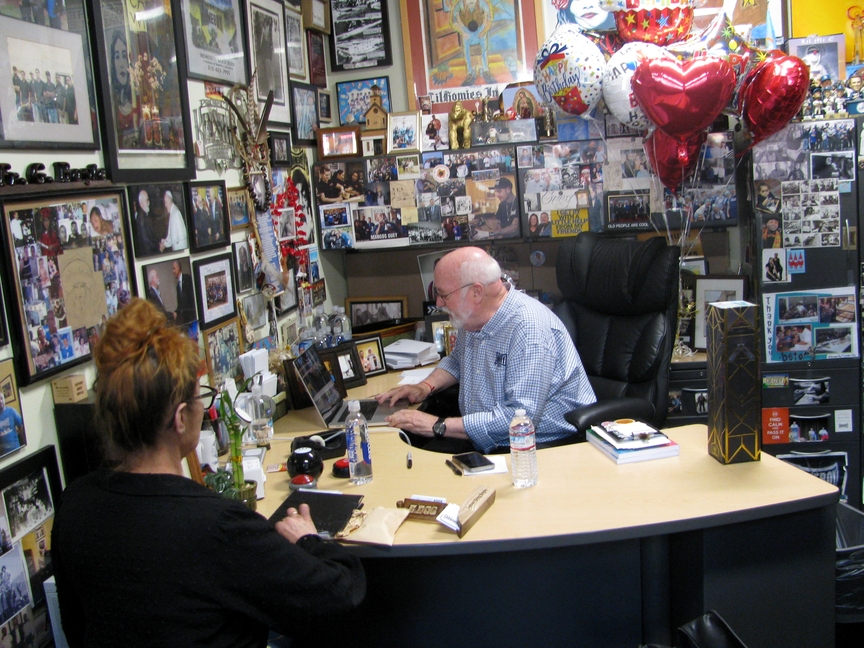 Father Gregory Boyle at his office at Homeboy Industries in Los Angeles
As warring parties in the Middle East, Africa, and the rest of the world escalate violence, at Homeboy Industries warring gang members work side-by-side at Homegirl Café, Homeboy Bakery, and several other workplaces founded by Father Gregory Boyle in Los Angeles. The sidewalk in front of Homeboy Industries is bustling with gang members, many of whom have been rivals for decades, going in and out of the building, embracing and hugging and high-fiving each other, as I make my way towards the front door. In the short walk from my parked car to the front door, no less than half a dozen gang members approach me. The vibe is electric, the energy is raw, and immediately welcoming.
Father Greg grew up on the opulent West Side of Los Angeles, attending private colleges, earning master’s degrees in English and Theology, and following the Jesuit path to service. He was en route to becoming Dean of Students at the upper-middle-class private University of Santa Clara when he asked to be sent to Bolivia to learn Spanish. A year of working with poor people in Bolivia changed Father G’s life. He asked to be sent to the poorest place imaginable, so he was sent to Dolores Mission Church in East Los Angeles in the midst of the highest rate of crime and murders in the gang capital of the world, Los Angeles. Instead of railing against sin, Father Greg got to know the people. He rode his bicycle in the middle of the night among the projects; stared down the barrels of guns pointed at him by strung-out, 13-year-olds in the heat of gang-banging. He accepted them all as fellow human beings. He saw their needs – jobs and kinship.
I had the honor of sitting down with Father Greg in his office. Just outside the glass walls and door of his office were multitudes of former and current gang members who were waiting their turn in rows of folding chairs in the lobby of Homeboy Industries to consult with him.
On May 20, 2026, I had the following conversation with Father Gregory Boyle:
RITKES: What was it like for you growing up in L.A.?
BOYLE: I won the parent lottery, and the zip code lottery, and the education lottery. I have five sisters and two brothers, and wonderful parents. I was born on the West Side of the gang capital of the world, but in the Wilshire area. I didn’t have any of the issues that I encountered 42 years ago when I came to the Eastside.
RITKES: You went to Catholic High School, and then where’d you go to college?
BOYLE: Loyola Marymount University.
RITKES: And you went to grad school?
“Mother Teresa diagnosed the world’s ills in this way: we’ve just ‘forgotten that we belong to each other.’ Kinship is what happens to us when we refuse to let that happen. With kinship as the goal, other essential things fall into place; without it, no justice, no peace. I suspect that were kinship our goal, we would no longer be promoting justice – we would be celebrating it.”
from Tattoos on the Heart, Gregory Boyle (2010)
BOYLE: Undergrad at LMU, and then I went to Gonzaga, got my B.A. in English, and then got my M.A. in English from LMU, and a couple of degrees in theology after that.
RITKES: When you were studying theology, had you already decided to become a priest?
BOYLE: Oh yeah. It was all part of being a Jesuit.
RITKES: When did you make the decision?
BOYLE: Oh, a long time ago, 54 years ago.
RIKES: Were you in high school?
BOYLE: Yeah, right after graduating from high school.
RITKES: For your early training, you were sent to Bolivia. What impact did working in Bolivia have on you?
“I went to Bolivia, and it turned me inside out…. It was the poorest country in the hemisphere in those days … There was something about being with these people who were just remarkable, and generous and kind and loving and banded together. There were all these layers of how they were. It was such a gracious, heart-opening moment for me. It broke my heart wide open.”
BOYLE: I was supposed to go to Santa Clara University to be on the campus ministry team, but I still had to do another year of theology to finish up my degree. But then I said, “Well, can I take a year off just to learn Spanish?” It was after I was ordained a priest in 1984. Then I went to Bolivia, and it turned me inside out. Then it was like, “Gosh, I can’t go to Santa Clara because I’m a changed person.”
I begged my provincial, “Please don’t send me there. Send me to the poorest place where I can use my Spanish.” And he sent me to the Dolores Mission in Boyle Heights.
RITKES: What happened in Bolivia?
BOYLE: It was the poorest country in the hemisphere in those days, poorer than Haiti; it was hard to imagine. There was something about being with these people who were just remarkable, and generous and kind and loving and banded together. There were all these layers of how they were. It was such a gracious, heart-opening moment for me. It broke my heart wide open.
RITKES: This was in the early 1980s?
BOYLE: That would have been 1984 to 1985.
RITKEs: Was war going on in the region?
BOYLE: No, it wasn’t war. It was just really poor.
RITKES: You point out in your book, Forgive Everyone Everything, that 200 references in scripture ask us to take special care of the poor. You also state that our compassion for what Martin Luther King called “the last, the least, and the lost” lessens our service to those on the margins and increases our kinship with them. This is a premise that runs throughout your books. Can you explain this idea of kinship?
BOYLE: Well, kinship is kind of an exquisite mutuality, especially at a time when people want to go to the margins to make a difference. I always say, “Well, if you do that, then it’s about you. But if you go to the margins so that the folks there make you different, then it’s about us. The goal is kinship, which is us. Obliterating once and for all the illusion that we’re separate, that there is an us and a them. Once we can obliterate that, you’re left only with the sense that we’re united and connected and together.
RITKES: How is that distinguished from service?
BOYLE: Well, service is a hallway that leads you to the ballroom. You want to get to the ballroom, which is the place of connection, and kinship, and relationship. Pre- COVID, we had probably 350 volunteers. We don’t have that many now. In the old days, people would come here and say,” I want to volunteer here. ” I remember a woman said once, “I have to volunteer,” and I said, “Why do you have to volunteer here? “She goes,” Well, I believe I have a message these young people need to hear.” I thought, “Oh, yikes!” The minute you lose that message, I hope you come back to us. We don’t want any damn message here. We don’t need your message. Can you listen? Can you love? Can you receive people? Can you allow your heart to be altered? Can you let yourself be reached by these folks? That’s who we want here.
It’s not like I have these skill sets or I can teach this, but it has to begin as a relationship, and you listening and receiving who these people are. Then maybe later on, you’re helping somebody study to take the written DMV test, helping with something as small as that.
RITKES: I see the practice of that, walking into your building here with the people, so incredibly warm and expressing so much welcome to a stranger.
BOYLE: Yes, everybody says that. It’s tangible.
RITKES: I want to move in here.
BOYLE: I’m glad.
RITKES: It’s what you created. Father Greg, how did you wind up at the Dolores Mission Church in Boyle Heights?
BOYLE: I came back from Bolivia, then I finished theology, my one year of theology that I had delayed, and then that’s when I went to my superior. We have provincials who decide where we go, and it just coincided with a need. It’s a hard place, the Dolores Mission — nobody lasted very long, and he goes, “Oh my God, I need somebody there.” So I went there thinking I’d be, like, number three on the totem pole. But I went there as pastor, the youngest pastor in the history of the Los Angeles Archdiocese, because nobody was made a pastor at 30. I was only 30, and it was just the greatest thing that ever happened to me.
RITKES: What was going on there when you started?
BOYLE: Probably the first two years, 1986 to 1988, immigration was mainly the thing, and we had lots of issues in those days, similar to what we have now with ICE. You forget what happened in those days. And then in 1988, I buried my first young person killed because of gang violence, and that changed everything. And then it was morning, noon, and night — shootings all the time.
“No hopeful kid has ever joined a gang in the history of the world.”
RITKES: Was it the proliferation of guns that changed things?
BOYLE: Well, it was a combo of guns and crack that had just hit the scene at that point. We also started to have kind of the movie versions of gangs, like in the movies Colors, Blood In Blood Out, American Me, all these movies that young people in the barrio would go to see, and think, “Okay, that’s who we are.” And it was an odd kind of convergence of all these things, but that was the decade of death, which was 1988 to 1998, and the highest moment was 1992 when we had a thousand gang-related homicides in LA County.
RITKES: Being new in that situation, how did you approach it?
BOYLE: We just responded to things. The first thing was that there were junior high school-age gang members who were kicked out of their schools. Nobody wanted them. In the middle of the day, they were wreaking havoc, selling drugs, writing on walls. They were violent. So I went to them, and I said, “If I found a school that would take you, would you go? And they all said, “Yeah,” they would. And then I couldn’t find a school that would take them. So we started a school in the convent. I asked the nuns to move out if they wouldn’t mind, and then we turned the convent into a school.
RITKES: Public schools wouldn’t take these kids?
BOYLE: They had alternative schools for high school kids, very few in those days. They had none for junior high. So we started one.
RITKES: Was the gang presence pretty noticeable there?
BOYLE: In 1988, yeah. It became a really proliferating thing.
RITKES: Is the existence of gangs rooted in poverty?
BOYLE: Mainly, but no hopeful kid has ever joined a gang in the history of the world. It’s more about a lethal absence of hope. To the extent that poverty contributes to that despair, yes, but it’s mainly about kids having no hope. And so, how do you infuse hope in kids for whom hope is foreign? You want to ignite the pilot light of hope within. We started a jobs program; first a school, and then a jobs program, because they kept saying, “If only we had jobs…”
RITKES: One of your slogans is, “Nothing stops a bullet like a job.”
BOYLE: Yeah, which we did in the early days, and then we don’t use it anymore. About 15 years ago, we shifted. Where it was the idea that an educated gang member may or may not reoffend, and an employed one may or may not reoffend, we landed on the notion that a healed gang member will not ever go back to prison.
RITKES: How does a gang member heal?
BOYLE: Well, that’s kind of what the whole notion of this place is. It’s a therapeutic community. It’s everybody applying a dose so people feel safe and they feel seen, and they feel cherished. It’s not like, okay, you need healing, so go to a therapist; you need tattoos removed, go to a tattoo removal clinic; you need legal assistance in the second-floor office upstairs. The whole place is about healing. It’s a culture of healing. They’re here for 18 months in the training program. We call it “training.” It’s not really training; it’s really healing. And it’s interesting because a psychiatrist once said to us, “Oh, 18 months. Yeah, that corresponds to the 18 months it takes for an infant to attach to the caregiver.”
RITKES: Oh, really?
BOYLE: Yeah. We were thinking, well, two years is too long, one year is too short. How about 18 months? So, we arrived at it kind of haphazardly. But later on, they went, “Oh, I get why you chose 18 months.” But it made sense to us, too, because this is about attachment repair. People come here with a disorganized attachment; mom was either frightened or frightening, and you can’t calm yourself down if you’ve never been soothed. So you come here, and people are soothed. They come here barricaded behind a wall of shame and disgrace, and the only thing that can scale the wall is tenderness. You want to create a place of tenderness, which was the vibe I think you were feeling even before you walked into the building.
RITKES: Yeah.
“I’ve never met an evil person, ever. And you would think, since I have a program that only deals with gang members and people who’ve been incarcerated, you might think I have. But I never have. On that I’m certain. I’ve met broken people, I’ve met wounded people, I’ve met despondent people, but I’ve never met an evil person.”
BOLYE: But it’s all hands on deck. It’s not like healing isn’t found upstairs in the therapist’s office [above Father Greg’s office, on the second floor of Homeboy Industries, are the mental health and therapy offices]. It is, but it’s not exclusively because people are the security guards, the homie who has goggles on, and helping the doctor take tattoos off. You should get a tour here.
RITKES: That would be great. How did you come to this realization that this is what it takes to heal?
BOYLE: It all evolved while we were responding to several things. A guy came in here who was two days out of Corcoran State Prison. He had on his forehead a big, huge tattoo that said, “Fuck the World.” And he said, “I’m having a hard time finding a job.”
[they laugh]
BOYLE: I said to him, “Maybe we can put our heads together.” I went to our local Eastside Boyle Heights White Memorial Hospital. Somebody said, “Hey, there’s a dermatologist who has a laser machine.” I convinced them to give me one hour a month to chip away at his tattoo, and for a couple of others. Then, in no time, I had a waiting list of 3,000 gang members who wanted the same treatment.
BOYLE: [to Julissa Diaz, his assistant] Can you see if you can find Cisco or somebody to take Daniel on a tour when we’re done? … Yeah … everything evolved … It wasn’t like I said, “You know, tattoos would be good to get them removed.”
I’m not a proponent of, “Oh, kids join gangs because they want to belong or have a family.” Kids aren’t seeking anything when they join a gang, but are always fleeing something — always. The problem is we think it’s about attraction, rather than saying, “What are they fleeing?” They’re fleeing a mom who put cigarettes out on them or held his head in a toilet until he nearly drowned as she’s flushing it. That’s why he’s joining a gang.
RITKES: You state in Tattoos on the Heart that frequently children have no choice but to be raised on the streets and that gangs are a bastion of conditional love. Can you describe the need that gangs fulfill?
BOYLE: I’m not much of a proponent of, “Oh, kids join gangs because they want to belong or have a family.” I think it’s important to dispel the notion that there’s a pull factor when, in fact, there is only a push factor. Kids aren’t seeking anything when they join a gang, but are always fleeing something — always. The problem is we think it’s about attraction, rather than saying, “What are they fleeing?” They’re fleeing a mom who put cigarettes out on them or held his head in a toilet until he nearly drowned as she’s flushing it. That’s why he’s joining a gang. Gang members will say this [that they are attracted to gangs], and this is part of the reason we believe it. Because gang members, if you ask them, they’ll say wine, women, and song; join a gang, see the world. Attraction is all pull [as opposed to push, as a result of fleeing something]. Gang members won’t acknowledge fleeing — because then that would mean they have to talk about some of their adverse childhood experiences, or sexual abuse. There are 10 things — like physical abuse, or a father in prison, or parents addicted or neglect. And so, around here, that’s part of the parlance — you can say, for example, I’m a zero. I don’t have any of those 10 things in my life, in my history, but almost everybody here is a nine or a 10, which is unheard of to have all those things. Some say nine, because the 10th is sexual abuse, and people, especially men, don’t want to talk about that. So maybe they would admit only to nine, but that’s just horrendous what kids have to carry. And so that’s what you’re trying to excavate here, so that they cannot numb their pain. If they don’t transform their pain, they’re going to continue to inflict it, and that’s the notion, that’s the idea here.
RITKES: How do you accomplish that at Homeboy Industries?
BOYLE: Well, again, it’s the culture, it’s the environment, it’s the vibe, it’s more home than home. Everybody knows each other’s names, and everybody is giving a dose. We always joke about the security guards because they’re outside and they’re always giving a dose.
RITKES: I noticed that.
BOYLE: That’s why they call it sidewalk therapy. And this big, huge guy, Miguel, especially in the colder months when he has a big coat, and everybody hugs everybody. He’ll hug people, and then he’ll go like this — like check for guns, and he’ll go, “Hey, pal, do me a favor, put that [gun] right here in this pocket and I’ll give it back to you afterwards.”
He does this all the time. And then he’ll walk the kid to the corner far away, and the kid will take the gun back, and Miguel says, “Don’t ever do that again. Don’t disrespect this place.” And the kid says, “Okay, all right.” It’s all part of the dosing that everybody engages in. We want to be the opposite of the DMV. We don’t want to be like, “Okay, anger management? Go to window 43,” that kind of thing. Here, we help with anger management; we do all the menu stuff — anger management, domestic violence class, and lots of groups. We do all those things, but we don’t want to be that kind of check-the-box. We’d rather check the pulse than check the box.
“We could ask ourselves if God is conservative or liberal, but I think that’s the wrong question. Instead, we should ask: Is God expansive or tiny? Is God spacious or shallow? Is God inclusive or exclusive? What are the chances that God holds the same tiny point of view as I do? Well, zero.”
Father Gregory Boyle, Forgive Everyone Everything
RITKES: At Homeboy, you have the Homegirl Cafe, and your little office here; what else does Homeboy Industries have in this building?
BOYLE: We have 16 social enterprises, and they’re mainly offsite. We have silkscreen and embroidery, we have dog grooming, and we have electronic recycling.
RITKES: Here on site, there’s a large community of people.
BOYLE: Yeah, so here on site, we have the trainees here, but we also have a merchandise store, Homegirl Cafe, a bakery behind us — those are three of our 16s.
RITKES: Where’s your art academy?
BOYLE: The art academy is across the street. Joseph is your tour guide; he’ll take you there.
“At Homeboy Industries, the two principles that we embrace here are: everybody is unshakably good, no exceptions, and we belong to each other, no exceptions.”
RITKES: Some Christians interpret violence and crime committed by some of the homies as sin and evil and consider such people outcasts. You take a different view, and you write that the concept of sin for the past thousand years has not been particularly helpful. Can you tell us the problem with the concept of evil?
BOYLE: I think whenever we say “evil,” it’s just shorthand for not wanting to address stuff. I’ve never met an evil person, ever. And you would think, since I have a program that only deals with gang members and people who’ve been incarcerated, you might think I have. But I never have. On that I’m certain. I’ve met broken people, I’ve met wounded people, I’ve met despondent people, but I’ve never met an evil person. Once you find the thorn underneath, you go, “Ah, I see what it is.” You can understand: what does behavior have to do with goodness anyway? Nothing. Everybody’s unshakably good. What language is their behavior speaking — violence and Donald Trump. What language is behavior speaking? You go, “Oh, I get what it is. It’s narcissism.” Somebody is despondent, can’t imagine a future, so the present isn’t compelling.
All these things come into play, but the two principles that we embrace here are: everybody is unshakably good, no exceptions, and we belong to each other, no exceptions. And so we think around here that if we embrace those two beliefs, every single complex social dilemma would just disappear.
RITKES: Gangs can be very organized and work together. Do you see a day when homies might unite and organize around issues like better wages against large corporations and property?
BOYLE: Yeah, that happens here, but we don’t want gangs to become the Kiwanis Club. We don’t want to transform the gang into something. It’s one gang member at a time because here every single person has multiple, multiple enemies. People they used to shoot at, now they’re making croissants in the bakery with each other, and that’s the idea. We don’t want to organize gangs into becoming something positive because there’s nothing positive in a gang. Nothing.
RITKEKS: Why can’t they be an organized …
BOYLE: Because then you serve the cohesion of the gang, and all gangs are about one thing: we are the guys who hate those guys, and so because it’s based on that, we go, “Well, that’s not a healthy place to be.”
We help gang members, but we don’t think, “How can we keep the Crips together and at peace with the Bloods?” No, we don’t do that because that serves the cohesion of the gang. It provides oxygen, and oxygen is not a good thing for gangs.
RITKES: What about the community of the gang? What about the …
BOYLE: I think all that stuff is mythic. It’s not real. In gangs, it’s “one false move…” It’s conditional love. It’s not unconditional love. Gang members never say, “No matter what you do, we’re always going to be in your corner.” Well, they do say that, but they don’t believe it. It’s a “one false move” organization, which is why you have all sorts of homies who are no longer loved and taken care of.
Lorem ipsum dolor sit amet, consectetur adipiscing elit. Ut elit tellus, luctus nec ullamcorper mattis, pulvinar dapibus leo.